Bed Blanket Sizes: A Simple Twin-to-King Guide
Choose a bed blanket by its listed width and length: measure the mattress, decide on side and foot drape, then check the exact dimensions before buying.
For readers who want the practical limits before acting on a sleep claim.
Evidence Explainer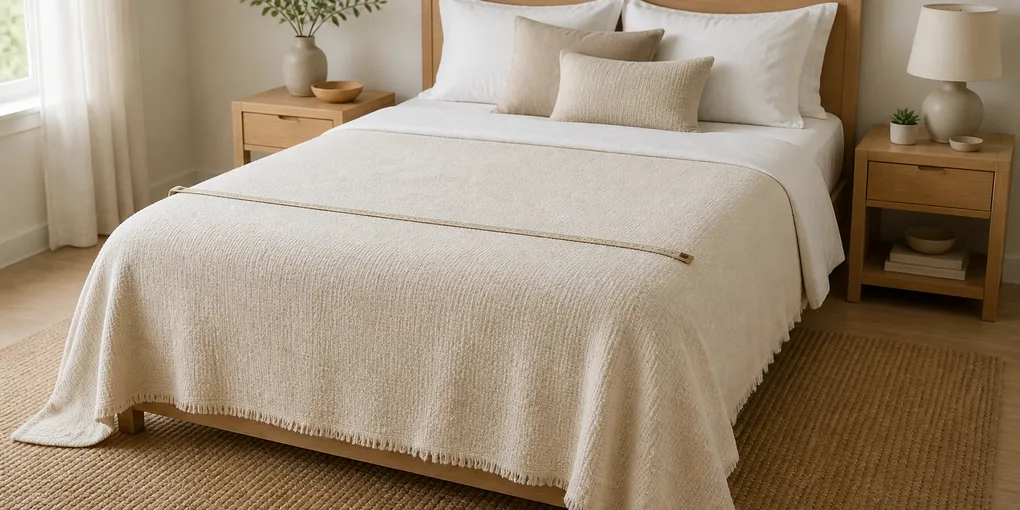
The blanket says Queen, but it barely reaches the foot of the bed and leaves almost no fabric at the sides. That is usually a dimensions problem, not a mysterious difference between bed labels. Measure your mattress, add the drape you want, and compare the result with the exact width and length on the blanket listing.
Twin, Full, Queen, and King are useful starting labels. They are not a promise that every blanket in that category will cover your bed in the same way. A brand may group sizes, make one dimension generous and the other short, or use the same blanket for a King and California King. The numbers tell you what the label cannot.
Start with the mattress, not the blanket label
Measure the sleep surface from side to side and from head to foot. If a topper stays on the bed, include it when you think about the edge the blanket has to clear; its height can make a short side drop feel even shorter.
Common mattress measurements are a useful reality check: a Twin is about 38 by 75 inches, a Twin XL is 38 by 80, a Full is 53 by 75, a Queen is 60 by 80, and a King is 76 by 80. A California King reverses the usual King tradeoff: it is typically narrower at 72 inches but longer at 84 inches. Those measurements identify the mattress, not the finished size of every blanket sold for it.
Write down three things before opening a size chart:
- mattress width;
- mattress length; and
- whether the blanket will sit loose at the foot or tuck under the mattress.
That last choice matters. A blanket that looks long enough untucked may come up short once a portion has to travel down the foot of a tall mattress and under its edge.
Add the side drape you actually want
For a loose top layer, start with a simple width calculation:
blanket width = mattress width + left-side drape + right-side drape
If you want 12 inches hanging on each side of a 60-inch-wide Queen mattress, look for at least 84 inches of blanket width. If you like a deeper, bedspread-style drop, add that larger amount on both sides. If the blanket is mainly for one sleeper on a shared bed, a smaller drop on the inside can be deliberate rather than a bad fit.
The same math makes a label mismatch obvious. A 92-inch-wide Full/Queen blanket gives about 16 inches of fabric on each side of a 60-inch Queen before you account for thickness or an unevenly centered blanket. A 96-inch-wide Full/Queen blanket gives about 18 inches per side. Neither is automatically better; the useful question is whether that drop matches the way you make the bed.
Treat length as a separate decision
Width decides the side drape. Length decides whether the blanket reaches from the head of the mattress to the foot with the finish you want.
For an untucked blanket, use this starting point:
blanket length = mattress length + foot drape + any head allowance
A Queen mattress is commonly 80 inches long. A 92-inch-long blanket leaves roughly 12 inches for the combined head and foot allowance before thickness changes the path. If you pull it high under pillows, most of that extra length is no longer available at the foot. A taller mattress, a lofty topper, or a deep foot tuck needs more length than the flat measurement suggests.
King and California King blankets are where the two dimensions deserve the most attention. A standard King mattress needs more width; a California King needs more length. A listing marked King/California King may be the right choice, but only if its published width and length match the direction your mattress needs.
Read the listing like a measurement record
Once you have your target width and length, compare the listing rather than the headline size. Keep this small record beside the product page:
| Check | What to compare |
|---|---|
| Width | Mattress width plus both side drops |
| Length | Mattress length plus the foot finish and any tuck |
| Size grouping | Whether one blanket is serving two bed shapes |
| Variant | The dimensions for the color and size actually selected |
| Care notes | Whether washing instructions could affect the size you keep |
Do not assume a Full/Queen or King/California King grouping has the same proportions from one maker to another. Current blanket listings illustrate the variation: one Brooklinen blanket lists Full/Queen at 96 by 92 inches and King/California King at 86 by 114, while another lists 92 by 96 and 114 by 96 for those grouped sizes. The name alone cannot tell you which dimension is generous.
If the listing does not publish both measurements, it cannot answer the fit question. Look for a size guide, ask the seller, or choose a listing that gives dimensions for the exact variant.
Use the bed you make, not a showroom outline
Before you decide that a blanket is too small, center it on the made bed and check four points:
- The side drape looks balanced when the blanket is centered.
- The foot still has enough coverage after pillows take up headroom.
- A tall mattress or topper has not used the extra fabric you counted on.
- If you tuck the foot, the blanket still reaches the mattress edge without pulling tight.
This check also helps when you are reusing a blanket from another bed. A King blanket can give a dramatic drop on a Queen, but it can also bunch at the foot if the length is not managed. A Queen blanket on a King may work as a personal layer, yet it is unlikely to give equal coverage to both sides.
The one limitation worth keeping in view
Mattress and blanket labels are conventions, while the listed dimensions are the purchase-specific evidence. The examples here use common mattress measurements and current brand size charts, but makers can change dimensions or use different tolerances. Check the selected blanket’s current width and length before buying.