How to Label Bedding Sets in a Small Closet
Make bedding easier to retrieve in a tight closet: label each complete set by bed and size, keep the label facing out, and give loose pieces one home.
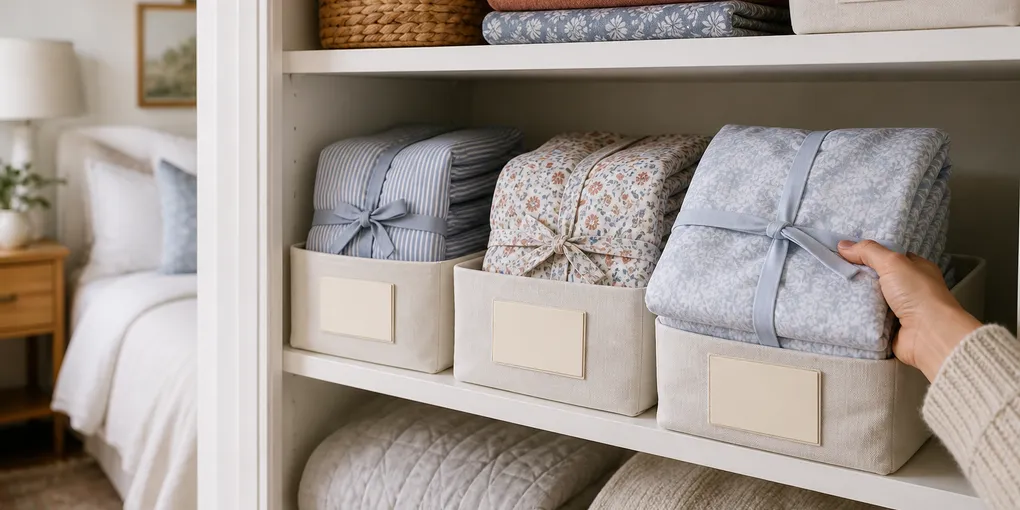
When every folded sheet looks roughly the same, finding the Queen set can mean lifting half the closet shelf. Give each complete set one visible name, keep the pieces together, and use the same short pattern on every label. In a small closet, the useful label is the one you can read before you touch the stack.
Start with the bed, then add the detail that separates similar sets. Queen · blue stripe is more helpful than sheets; Twin XL · guest room is clearer than a colour alone. The goal is a quick retrieval cue for the bundle at hand.
Name the set by the decision you make at the shelf
The first word should answer the question that matters when you open the closet: which bed does this fit? Put the size first, even if the room name feels more familiar. A guest-room label can become confusing when bedding moves to another bed; Queen · guest room still tells you both things.
Use one of these patterns and stay with it:
| If the sets differ by | Label pattern | Example |
|---|---|---|
| Bed size | Size · set | King · everyday |
| Room and size | Size · room | Twin XL · office |
| Similar sets for one bed | Size · visual cue | Queen · white grid |
| Seasonal rotation | Size · season | Full · winter flannel |
Choose labels that carry their own meaning rather than an inside story, such as new, nice, or back-up. If there are two plain white Queen sets, add a stable cue you can see before unfolding them: a thin blue hem, a sateen finish, or the month the set joined the closet. Put that cue after the size.
Keep the pieces that leave together together
Fold the fitted sheet, flat sheet, and matching pillowcases into one bundle. You can place the pillowcases inside the folded fitted sheet or wrap the stack with one pillowcase; the exact fold is less important than making the whole set move as one unit.
Loose pieces need a different rule. Pick one small bin, basket, or shelf section for extra pillowcases, spare shams, and unmatched flat sheets, then label it by piece rather than by bed: extra Queen pillowcases or King shams. That prevents a label for a complete set from promising something the stack no longer contains.
If a set is incomplete, mark it in a general pile with a simple Queen · missing flat sheet note. The next person can make a decision before stripping a bed. Once the replacement is found or the set is repurposed, remove that temporary note.
Put the label on the surface you see first
The label belongs on the shelf-facing edge of a bin, basket, or folded bundle. Stand at the closet opening and check whether you can read it before pulling anything forward.
This matters more in a tight space than matching containers do. The Container Store’s small-closet guidance calls out measured shelves, vertical storage, and labeled bins; IKEA’s current bedding-storage listings also show that cases come in several widths and heights. Measure the shelf opening before choosing a container, and let a simple tag or clip adapt to the surface you already use rather than rebuilding the closet around labels.
For a shelf with no bins, use a folded card tucked just under the front edge of each stack. For a soft case, use a tie-on or clip label instead of a sticker that may not stay put. For a clear container, still add a front label: seeing fabric through the side does not reliably distinguish a Full set from a Queen set in a hurry.
Reserve one overflow limit
A small closet gets harder to use when every spare sheet becomes a new stack. Give each bed size one ordinary home and set a physical limit for extras: one narrow bin, one labelled stack, or one shelf section. When it is full, decide whether the next item replaces a worn set, belongs with another bed, or needs a different storage location.
Keep the most frequently changed set at the front or on the easiest shelf. Seasonal, guest, or rarely used bedding can sit higher or farther back, as long as its label still faces the closet opening. The Container Store’s closet guidance similarly puts less-used items on higher shelves; the useful adaptation here is to keep the retrieval clue visible wherever the bundle lives.
Do a two-minute reset when the bedding changes
When you swap seasonal bedding or make up a guest bed, return the outgoing bundle to its labelled spot and check the label once. That is enough to catch a migrated pillowcase or a Full set that landed among Queen sheets.
Use this short reset:
- Match the folded bundle to its label before putting it away.
- Return loose pillowcases and shams to their separate labelled home.
- Move an incomplete set to its temporary note or piece bin.
- Face every label toward the closet opening.
This method works with the containers already in use. It depends on a label that names the bed, a bundle that represents a complete set, and one defined place for the pieces that belong outside that bundle.
One limitation to keep in view
Storage formats and label materials vary by shelf, bin, and household. This is a retrieval method; use the current dimensions and care instructions for any storage item you choose.